Sinclair UAS Training Takes Flight at the Montgomery County Fairgrounds
Dayton Daily News Article (Oct. 1, 2026) ---
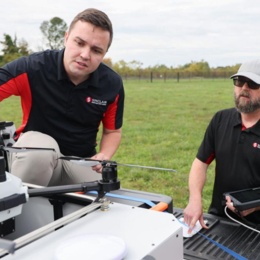
The drone rose from the bed of a Ford F-250, a white tether trailing beneath it as Andrew Wentworth coached a fellow Sinclair Community College employee through the flight.
But the Wednesday, Sept. 30, lesson near the Montgomery County Fairgrounds was about more than learning to fly.
Sinclair is expanding its role in drone training, teaching its own instructors as well as police officers, firefighters and privat
e-sector employees how to operate unmanned aerial systems, commonly known as drones.
Wentworth, deputy director of Sinclair’s UAS Training and Certification Center, was working with Tristan Giardullo, a Sinclair UAS operations manager. Giardullo is among the staff members learning not only how to operate drones, but how to teach others to fly them.
Demand for that training is growing as drones become increasingly common tools for law enforcement, emergency responders and businesses.
There is a multitude of drones, Wentworth said. Demand for training in how to use them is only growing.
“The FAA has stated that to get a drone license there is no practical hand skills involved because every drone is so vastly different from another,” Wentworth said. “I couldn’t tell you how hard or easy they all were to fly, because it’s such a broad spectrum.”
Sinclair offers bachelor, associate and certificate regimens in UAS.
But a growing community of first responders are trying to get comfortable with drones, he said. Often, they’re turning to Sinclair.
“The key point here is: When people come to Sinclair to learn how to fly drones, we’re not the academic side of the house,” he added. “There are students taking academic classes and then doing flight operations at another department of Sinclair. We’re workforce development … You might call us, generally speaking, a special projects department.”
In fact, Wentworth isn’t sure that there remains a single holdout among area police departments that are not flying drones in some capacity.
“For search and rescue,” he said when asked about possible police uses. Crime scene investigations are becoming more common. Drones are even used to precisely measure tire skids marks at accident scenes, he said with a laugh.
Typically, a drone operator is permitted to fly only in areas that can still be seen by the operator, and that was the case Wednesday.
Sinclair’s drone lifted up from its Elistair “nest” in the truck bed connected to a white tether. To fly drones “beyond visual line of sight” — called “BVLOS” flying — requires additional approval from the Federal Aviation Administration.
As the drone — Wentworth called it a “bird” — rested in its nest, it was charged by a Jackery battery pack, with an ethernet cable stretching from the nest to a tablet in the truck cabin.
The drone is controlled by an operator via the tablet.
Going through a pre-flight checklist, Wentworth and Giardullo checked more than dozen parameters.
“Battery remaining?” Giardullo asked.
“100%,” Wentworth answered.
“Checklists are lifesavers,” Wentworth said before the flight.
French drone manufacturer Elistair is appreciative of Sinclair’s work with the company’s “Khronos” model drone.
“Having their instructors certified on Khronos means U.S. operators can now be trained close to home, to the same standard we apply abroad and in Europe." Guilhem de Marliave, chief executive of Elistair, said in a statement a Sinclair spokesman shared with the Dayton Daily News.
The drone rose from the bed of a Ford F-250, a white tether trailing beneath it as Andrew Wentworth coached a fellow Sinclair Community College employee through the flight.
But the Wednesday, Sept. 30, lesson near the Montgomery County Fairgrounds was about more than learning to fly.
2029-12-28 23:59:00.0