Resources
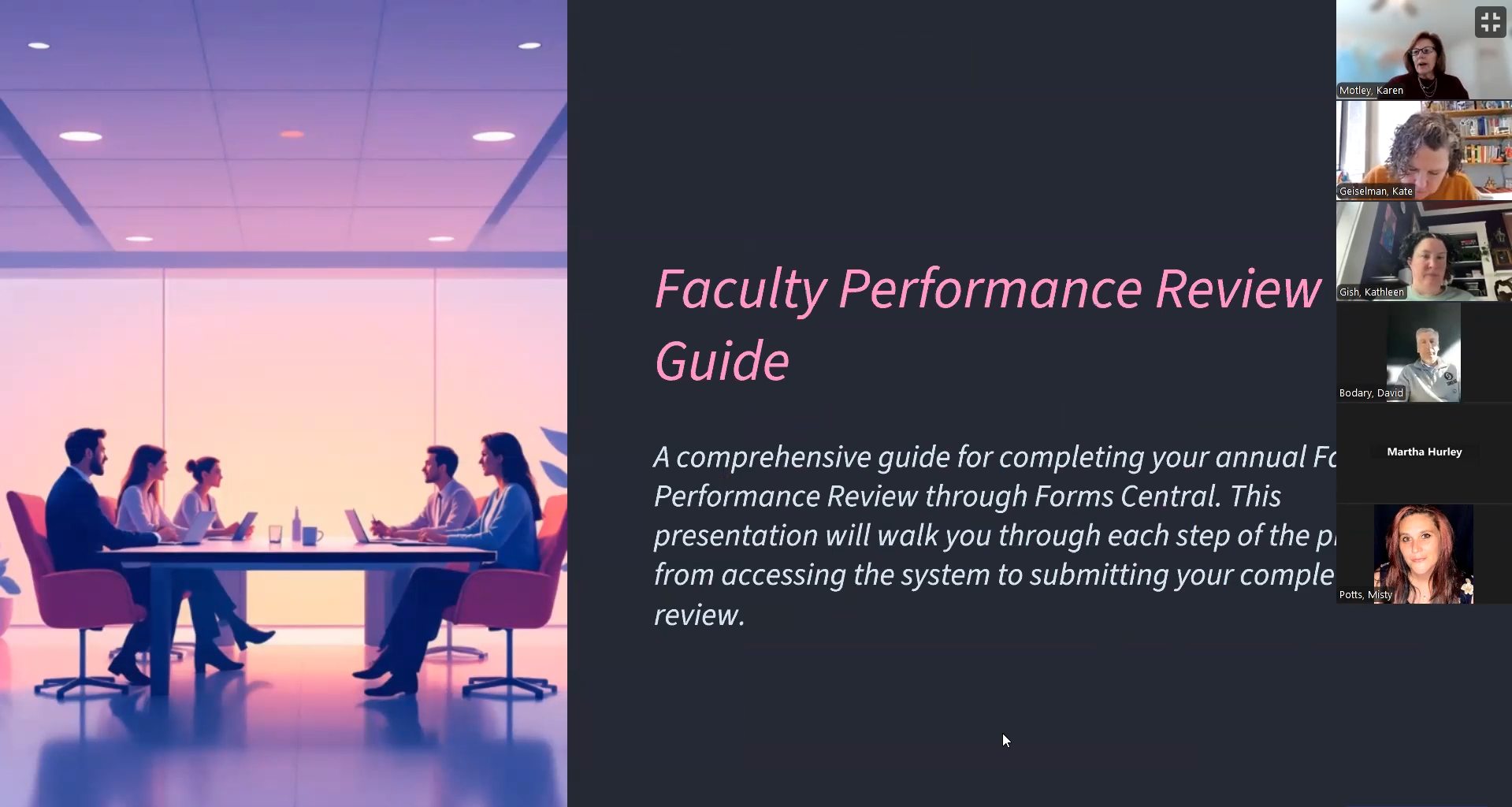
Faculty Performance Review (FPR) Guide
With the changes coming from SB1 there have been questions surrounding the FPR process and how it will change. If you have ever been confused or had questions regarding the FPR Process, Karen Montly put on a comprehensive workshop via Zoom to go over the process and answer some of the faculty's questions. Please feel free to bookmark this page so that you have it on hand for your review.
Click the thumbnail to be taken to this video.
If you run into any difficulties accessing the video, please send an email to: CTL@sinclair.edu.
Adjunct Faculty Certification Course
The Adjunct Faculty Certification Course (AFCC) is designed for adjunct faculty who are seeking to advance to Lecturer II status. Adjuncts must have taught at least 9 credit hours with Sinclair before beginning AFCC.
Steps to complete the AFCC course are listed below.
1. AFCC is a Canvas course found on eLearning. To be added to the class, please email the Adjunct Faculty Professional Development Fellow.
2. Adjuncts must also complete the “Preparing Your Teaching Shell” module in the Learning Lounge Canvas Community shell. To add yourself to the Learning Lounge, follow these directions:
a.) Click into the eLearning tile on your my.sinclair.edu page.
b.) Click on “Courses” on the left side of the page.
c.) Click on “All Courses” at the top of the page.
d.) Click on “Browse More Courses” at the top left of the page.
e.) Click on “Join This Page” in the Learning Lounge tile.
3. After you have access to the Learning Lounge community shell, please complete the “Preparing Your Teaching Shell” module.
4. Upon completion, you will receive a module completion certificate. Save the completion certificate as a PDF.
5. Enter the AFCC course and upload the completion certificate PDF to the Preparing Your Teaching Shell module.
6. Complete all AFCC course modules which include your review of a peer/colleague’s teaching and a review of your teaching by a peer/colleague. (Detailed instructions for how to do these peer reviews are included in the AFCC course).
7.) Upon successful completion of the AFCC, adjunct faculty will receive a completion email.
8. Contact your department chair to discuss the next steps for advancement to Lecturer II status. *Please note that advancement to Lecturer II status is at the discretion of the Department Chairperson and not the CTL. If the Department Chairperson approves the faculty member’s request to advance to Lecturer II status, an HR Action Form must be completed by the Chairperson and submitted to HR.
SMMART Criteria for Continuous Improvement Targets (CITs)
Updated 2025 for Contemporary Academic Practice
Continuous Improvement Targets (CITs) help faculty articulate focused, evidence-based goals that advance teaching, student learning, departmental priorities, and institutional mission. Strong CITs are Specific, Meaningful, Measurable, Achievable, Realistic, and Timely.
CITs are most effective when they are co-developed with the department chair and aligned with program and institutional goals, accreditation expectations, and the faculty member’s professional growth.
Specific
A CIT should clearly state what improvement will be made and to what aspect of teaching or professional practice it applies. Avoid broad or vague intentions. Identify a discrete improvement—not multiple unrelated goals within one CIT.
Examples:
- “Redesign the unit assessments in BIO 1100 to improve alignment with course learning outcomes.”
- “Implement structured peer feedback activities to strengthen student engagement in studio courses.”
- Purchasing materials or attending a workshop is not a CIT; the resulting improvement is.
Meaningful (Relevant & Impactful)
CITs should address high-impact areas of faculty work—teaching and learning, assessment, curriculum development, student success, and contributions that advance departmental or institutional priorities.
A meaningful CIT is tied to:
- Department or program outcomes
- Accreditation or compliance expectations
- Instructional innovation or quality improvement
- Student learning or retention
- Advancing inclusive, accessible, evidence-informed teaching practices
Focus on the limited number of activities that generate the greatest impact.
Measurable
A CIT must include clear evidence of success. Measures can be quantitative or qualitative but must be observable.
Quantitative measures:
- “Increase early-term student engagement as measured by LMS participation from 60% to 75%.”
- “Reduce assessment turnaround time from 5 to 3 days.”
Qualitative measures:
- “Revise lab manuals to improve clarity and reduce student errors, as evaluated through rubric-based review.”
- “Increase the quality of student final projects based on faculty scoring using the program rubric.”
Types of measures:
- Quantity (number of redesigned assignments, number of faculty-led workshops, etc.)
- Quality (improved rubric scores, error rate reduction, satisfaction ratings)
- Efficiency/Cost (reduced duplication of materials, streamlined processes)
- Timeliness (meeting key deadlines, improving turnaround time)
Achievable
CITs should fall within the faculty member’s reasonable sphere of influence. Rule of thumb: a faculty member should be able to take clear actions that significantly affect the outcome—even if not every factor is fully under their control.
Clarify expectations with your department chair regarding:
- Scope of authority
- Available time and resources
- Dependencies (e.g., IT, scheduling, clinical sites)
- Committee or department-level support
Realistic but Challenging
CITs should stretch professional practice without overwhelming faculty workload. They should add genuine value to teaching and learning or departmental effectiveness.
A CIT is realistic when:
- Required resources and information are available
- The timeline fits within the academic year
- The improvement is important enough to warrant focused time
- The faculty member has (or will develop) the needed skills
A CIT is challenging when it represents growth, innovation, or measurable refinement—not maintenance of existing performance.
Time-bound
CITs should specify when the improvement will occur and why the timeline matters.
Examples:
- “Implement revised assessments by the start of Fall 2026.”
- “Complete curriculum alignment review by Week 8 to prepare for accreditation reporting.”
Timeliness ensures CITs are connected to institutional cycles (assessment, accreditation, scheduling, program review) and serve students when needed.
Collaborative Development of CITs
CITs are developed jointly by the faculty member and the department chair. Faculty members draft their initial goals; chairs help refine them to ensure alignment with program standards, unit goals, and college priorities.
Summary of the SMMART CIT Framework
|
SMMART Component |
Contemporary Definition |
|
Specific |
Clear, focused description of the improvement to be accomplished. |
|
Measurable |
Evidence—quantitative or qualitative—indicating success. |
|
Meaningful (Relevant) |
Aligns with teaching excellence, student success, and unit/college priorities. |
|
Achievable |
Falls within the faculty member’s sphere of influence and ability to affect. |
|
Realistic but Challenging |
Requires growth; supported by available resources and time. |
|
Timely |
Specifies a reasonable timeline aligned to academic cycles. |
Career Readiness Modules
The Career Readiness Modules Faculty Guide provides everything you need to confidently integrate Sinclair's ready-made Canvas modules into your course. Discover flexible implementation strategies, sample activities, and best practices that help students connect coursework to future career success with minimal additional preparation.
Faculty Guide to Career Readiness Modules
Mitigating Learning Loss Initiative
Faculty interested in applying for the Center for Teaching and Learning (CTL) Learning Challenge Grants should use the application below. Be sure to submit your completed application to the CTL: ctl@sinclair.edu
CTL: Factuly Learning Challenge Grant Application
Please note that this application is due no later than Friday May 8th by 5:00 PM
The Center for Teaching and Learning at Sinclair Community College is proud to support faculty interested in participating in the Mitigating Learning Loss Initiative. There are many great resources available.
What is Learning Loss?
According to the Lumina Foundation and as cited in Donnelly et al., 2021, Learning Loss refers to the deterioration of knowledge, skills, and competencies, often because of an extended length of time away from or gap in education. Some of the most evident examples of learning loss in recent years look at how the COVID-19 pandemic impacted student learning. Students’ schedules were disrupted, and they faced gaps in access and continuity to education. Additional types of learning loss can also include unfinished learning, where benchmarks were abruptly changed.
Additional Learning Loss and Psychological Measurement Resources
Pandemic Learning Loss and COVID-19: Education Impacts
Why Mental Health is the Key to Dealing with Learning Loss
Learning Loss and Learning Recovery
FFPDD Resources
If you want to review the presentation given to us by a member of the ADHAHS, Taneah Matthews, during the Fall Faculty Professional Development Day, click here to access the presentation:
Teaching and Learning Resources
Below are some resources to assist faculty with policy, procedure, teaching, and learning topics.
-
- A Guide for Staff and Faculty: Responding to Student Behavior Concerns: Designed to provide guidance to staff and faculty who may encounter disconcerting student behavior, this guide will help you recognize and effectively respond to a range of behaviors. Available via Student Conduct.
- Student Affairs Referral Sheets - Use this form to refer students to Career Services, Accessibility Services, Student Support Services, Student Leadership Development, Judicial Affairs, Tutorial Services, Veteran Services, Counseling Services, Pathways to Completion, Ombudsman, Minority Student Success, Tartan TOPS, Sinclair Talks, and/or Campus Ministry. Visit Website.
- Academic Integrity Policy: This policy addresses willful acts of cheating, dishonesty, and plagiarism and establishes common procedures to be followed when such acts occur. The intent of the policy is to improve students' understanding of academic integrity while affirming the concepts and philosophies established in the Sinclair Community College Honor Code. More information available via Judicial Affairs. For a copy of slides from Fall Professional Development Day 2023 email ctl@sinclair.edu.
- Family Educational Rights and Privacy Act (FERPA): This policy requires institutions to adopt policies and procedures which (1) grant students access to their individual educational records; (2) establish procedures for students to challenge records believed to be inaccurate and (3) prevent the release of educational records, except directory information, to third parties without written consent from the student. More information available from RSR.
- Ethics: Ethics is an important part of being a professional faculty member. It is important to review the faculty handbook and your disciplinary code of ethics. The American Association of University Professors has a good website to review. Click here for more information.
Service Learning Opportunities
- If you would like a Profile in Service Learning created to communicate the results of your Service Learning projects contact service.learning@sinclair.edu.
Sinclair Library
The Sinclair Library collaborates with faculty and supports teaching and learning in several important ways. A librarian is assigned to each department to purchase or license needed materials for the collection, design web-based research guides for a particular program or class, and provide research instruction that aligns with the core competencies of information literacy and critical thinking. Librarians can also assist faculty with identifying and locating learning materials, using citation management software, navigating copyright and intellectual property issues, and integrating library resources into Angel. The library provides course reserves, a collection of books and supplemental readings supplied by faculty for students to use in the library for limited periods of time. The Sinclair librarians look forward to working with you in any way to help your students succeed. Faculty resources on teaching and learning.
These organizations support faculty development and have good resources: